How to Crochet for Beginners: Your First Stitches and First Project
Learn to crochet from zero: what to buy, how to hold the hook, chain and single crochet, plus an easy first dishcloth you can finish this weekend.
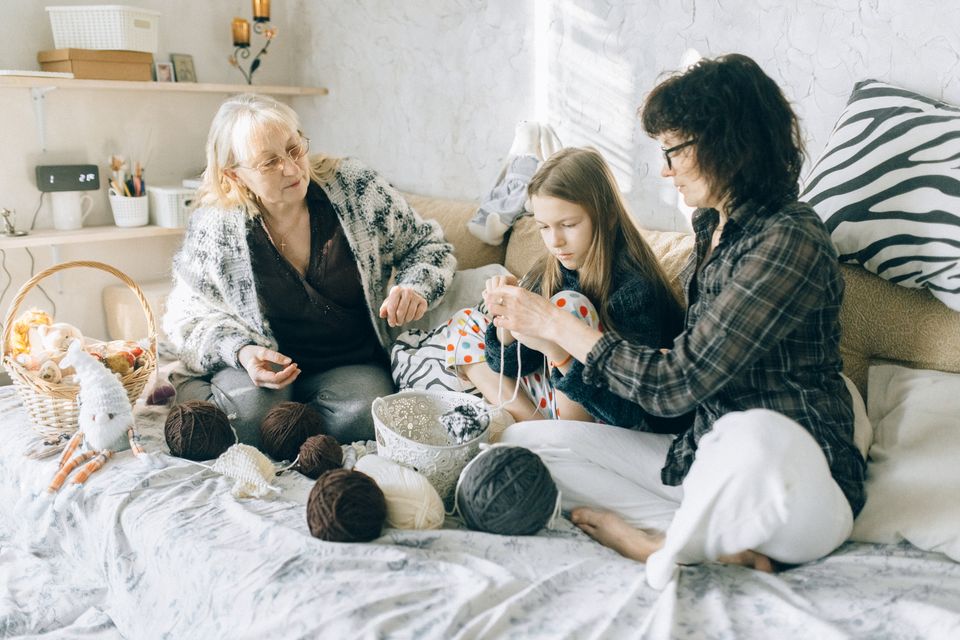
Crochet looks complicated from the outside, but it is built from one simple move repeated over and over: pull a loop of yarn through another loop. Once your hands learn that move, every stitch you’ll ever need is a small variation on it.
This guide takes you from a brand new hook to a finished first project. You’ll learn what to buy, how to hold everything, the two stitches that make up most beginner projects, and a dishcloth pattern that uses only those two stitches. We use US crochet terms throughout, because most patterns online do.
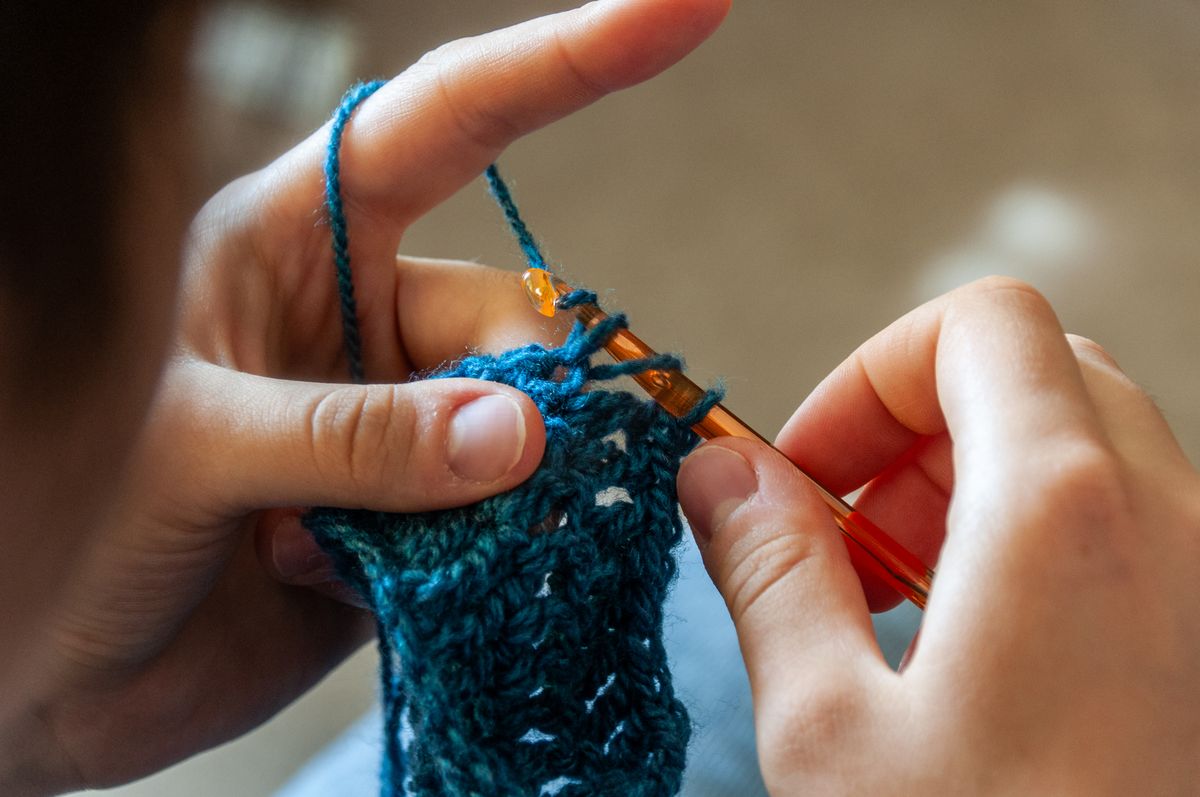
What you need before you start
You don’t need a craft room or an expensive kit. You need a hook, a ball of yarn, scissors and a yarn needle. That’s it.
The one choice that really matters is the yarn. Beginners often grab the prettiest yarn in the shop, and it’s usually fuzzy, dark or textured, which makes it almost impossible to see where your stitches are. For your first projects, choose:
- Worsted weight yarn, labeled with a number 4 on the band
- A smooth texture: cotton or a plain acrylic
- A light, solid color: cream, pale yellow, light blue or sage
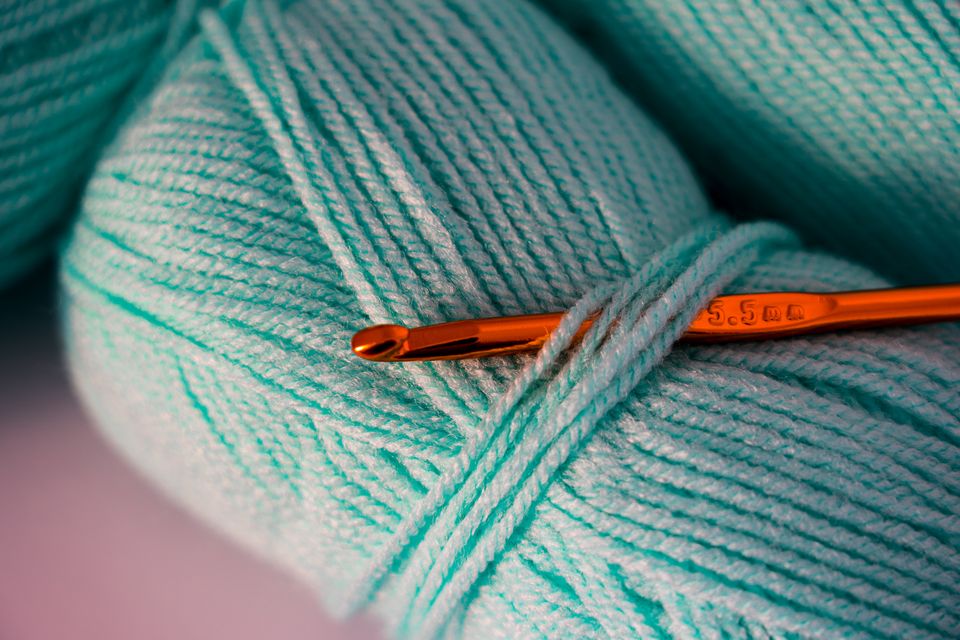
Pair it with a 5 mm (US H-8) hook. Check the yarn label: it usually suggests a hook size, and for worsted weight it will be somewhere around 5 to 6 mm. Many designers use 5 mm with worsted for a slightly firmer fabric. If you want the full explanation of sizes and weights, our crochet hook sizes and yarn weights guide covers it.
How to hold the hook and yarn
There are two common ways to hold a crochet hook, and neither is wrong:
- Pencil grip: hold the hook like a pen, between thumb and index finger, with the end resting on top of your hand.
- Knife grip: hold it like a dinner knife, with your hand over the hook and the handle under your palm.
Try both for a few minutes and keep whichever feels natural. If you’re right-handed, the hook goes in your right hand. Left-handed crocheters usually mirror everything and hold the hook in the left.
Your other hand controls the yarn. Drape the working yarn (the end attached to the ball) over your index finger and let it run loosely through your other fingers. This hand creates the tension: how tight or loose the yarn feeds to the hook. Too tight and your stitches are hard to work into; too loose and they look sloppy. Even tension is the skill that takes longest to learn, and it improves on its own with practice.
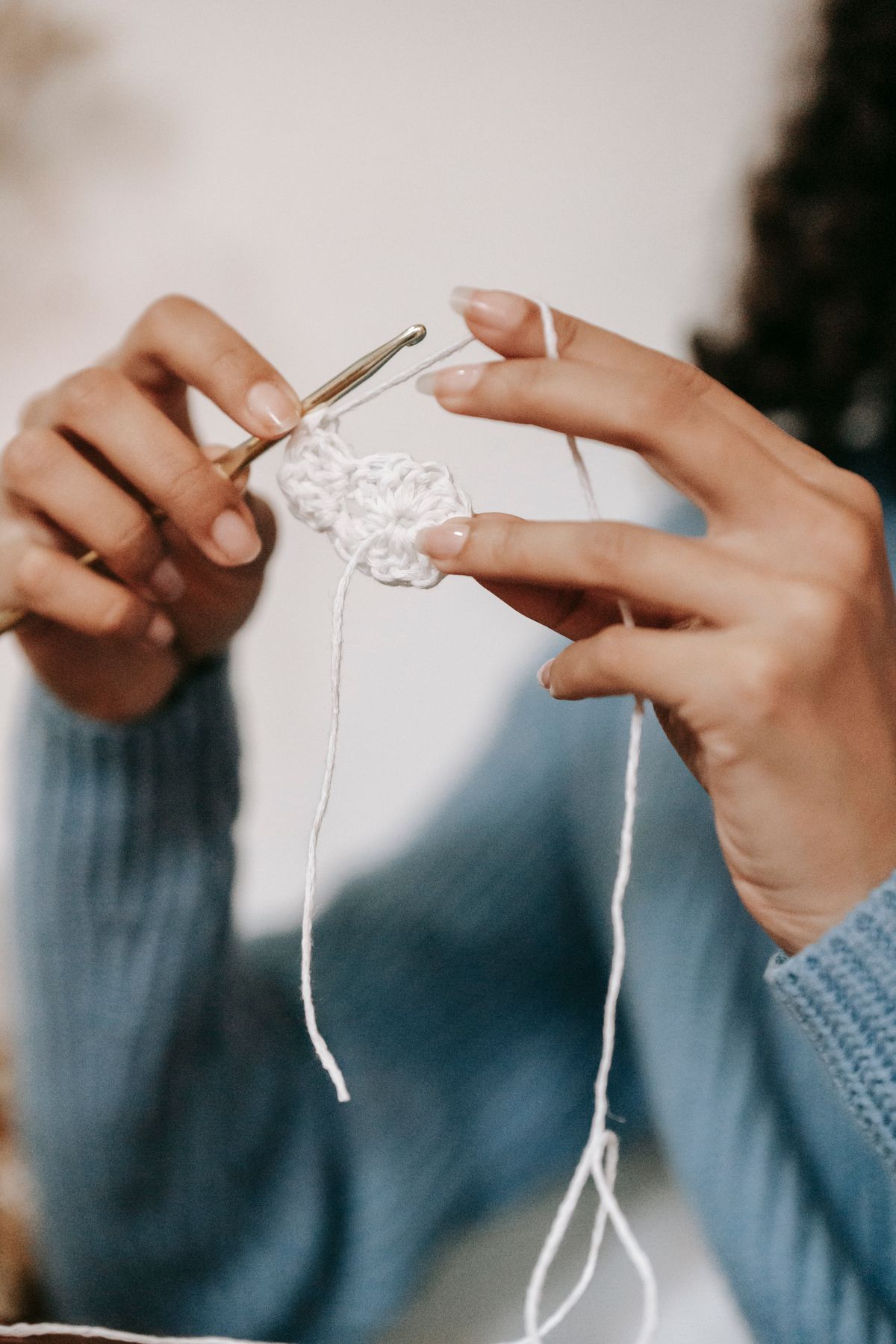
Step 1: Make a slip knot
Every project starts with a slip knot on the hook.
- Make a loop with the yarn, crossing the tail end behind the working yarn.
- Push a little of the working yarn up through the loop to make a second loop.
- Put that new loop on your hook and gently pull both ends to snug it up.
It should slide on the hook but not fall off. If it’s strangling the hook, loosen it.
Step 2: Crochet a chain
The chain is the foundation row for most flat projects.
- With the slip knot on your hook, wrap the working yarn over the hook from back to front. This is called a yarn over (yo).
- Pull the hook, with the wrapped yarn, through the loop on your hook.
That’s one chain stitch (ch). Repeat to make more. Each chain looks like a small “V” on the front. When you count chains, don’t count the loop on the hook or the slip knot.
Practice chaining until the Vs look roughly the same size. That’s your tension starting to even out.
Step 3: Single crochet
Single crochet (sc) is the workhorse stitch. It makes a dense, sturdy fabric, which is perfect for dishcloths, baskets and pot covers.
To single crochet into a chain:
- Insert the hook into the second chain from the hook (skip the first one next to the hook).
- Yarn over and pull up a loop. You now have 2 loops on the hook.
- Yarn over again and pull through both loops. One single crochet done.
- Insert the hook into the next chain and repeat.
When you reach the end of the row, you chain 1 and turn your work over so you can crochet back along the top of the row you just made. That chain 1 is a “turning chain” and does not count as a stitch in single crochet.
On every row after the first, insert your hook under both loops at the top of each stitch (the little V lying on top), not just one.

Step 4: Count your stitches
This is the habit that separates neat projects from wobbly ones. Count the stitches at the end of every row. If you started with 25, you should end with 25.
The two classic beginner mistakes are:
- Skipping the last stitch of a row, which makes your work shrink into a triangle
- Working twice into the first stitch (or into the turning chain), which makes it grow
A locking stitch marker in the first and last stitch of each row solves both.
Step 5: Fasten off and weave in ends
When your project is finished, cut the yarn, leaving a tail about 6 inches long. Yarn over and pull the whole tail through the loop on your hook, then tug it snug. That locks the last stitch.
Thread the tail onto a yarn needle and weave it back and forth through the stitches on the wrong side for an inch or two in different directions. Trim what’s left. Do the same with the starting tail.
Your first project: a simple single crochet dishcloth
A dishcloth is the perfect first project. It’s small, quick, useful, and it doesn’t matter if it’s not perfectly square. Use cotton: it’s absorbent and holds up to washing.
Pattern (US terms):
- Foundation: Chain 26.
- Row 1: Single crochet in the 2nd chain from the hook and in each chain across. You should have 25 sc. Chain 1 and turn.
- Row 2: Single crochet in each stitch across (25 sc). Chain 1 and turn.
- Rows 3 onward: Repeat Row 2 until the piece is roughly square. With worsted cotton and a 5 mm hook that’s usually around 28 to 30 rows.
- Finish: Fasten off and weave in both ends.
Your edges will probably be a bit uneven. That’s normal. Make a second one and compare: you’ll see the difference immediately.
Common beginner problems and quick fixes
My stitches are so tight I can’t get the hook in. Relax your yarn hand, and make sure you’re forming each new loop on the thick part (the shaft) of the hook, not on the narrow throat near the tip.
My first row is a twisted mess. Working into a chain is the hardest part of crochet, even for experienced makers. Chain a little more loosely, or try a hook one size larger just for the foundation chain.
My hand hurts. You’re probably gripping too hard. Take breaks, stretch, and consider a hook with an ergonomic handle.
I can’t tell where to put my hook. Switch to a lighter yarn color and work in good light. Look for the V on top of each stitch.
What to make next
Once you can single crochet comfortably, learn double crochet. It’s taller and faster, and most blankets and granny squares use it. Then try one of these:
- A chunky single crochet coaster set or pot cover
- A simple striped scarf in double crochet
- A first granny square
Our list of easy crochet projects for beginners has more ideas sorted by difficulty, and when you’re ready to make things for your home, browse our crochet home decor ideas.
What you'll need to start
You can start for less than the price of a takeout lunch. These are the only things a beginner really needs.
-
A 5 mm (H-8) crochet hook with a soft gripStart here
The most useful beginner size for worsted yarn. An ergonomic handle makes long sessions much kinder to your hand.
-
Smooth worsted weight cotton or acrylic yarn
Pick a light, solid color so you can see every stitch. Avoid fuzzy, dark or novelty yarn for now.
-
Blunt yarn needle
For weaving in the ends so your project doesn't unravel.
-
Small sharp scissors
Any pair works, but a small pair lives happily in your project bag.
-
Locking stitch markers
Optional at first, but they save you from losing count at the start of a row.
Frequently asked questions
Is crochet easier than knitting for beginners?
Many beginners find crochet easier to start because you only work with one hook and one live loop at a time, so a dropped stitch is easy to fix. Knitting holds many live stitches on two needles.
What size crochet hook should a beginner use?
A 5 mm (US H-8) hook with worsted weight (4) yarn is the classic beginner combination. It is big enough to see your stitches clearly but not so big that the fabric gets loose and floppy.
How long does it take to learn to crochet?
Most people can chain and single crochet after one or two practice sessions. Getting even tension usually takes a few small projects, so expect your first dishcloth to look a little wobbly and your third to look much neater.
Why is my crochet getting wider or narrower?
You are adding or skipping stitches at the ends of rows. Count your stitches at the end of every row and use a stitch marker in the first and last stitch until it becomes a habit.
Should I learn US or UK crochet terms?
Learn the terms used by the patterns you plan to follow. Most free patterns online use US terms. The same stitch has different names: US single crochet is UK double crochet.
Photo credits
Thank you to Nataliya Vaitkevich, wal_ 172619, Miriam Alonso and Karina Lopez for sharing these photographs.